
This article does not fully represent my view of Donald Trump. It is a specific literary endeavor to map Trump's political journey to the classic hero's journey.
Having read several books related to the psychology of the subconscious and the monomyth of the hero’s journey, it struck me that, from his supporters’ perspective, Donald Trump’s journey in politics maps very closely to the hero’s journey.
Most progressive thinkers will see Trump as a villain. This is understandable as he is moving government and culture in the opposite direction from what they would prefer.a However, in order to map some phases of Trump’s journey to the hero’s journey, it is necessary to describe those phases from the perspective of those who support him. My goal here isn't to convince progressive thinkers that Trump is a hero. My goal is to explain why Trump’s political journey resonates so deeply with many voters.
This article explores one of the reasons Donald Trump resonates so deeply with many voters: his career in politics fits the classic monomyth of the hero’s journey. I will map Trump's career to six main stages of the hero’s journey and draw analogies to the oldest known recorded epic: The Epic of Gilgamesh.
Dream research by Carl Jung,1 along with geographical and historical research by Joseph Campbell2 indicates that the themes of the hero's journey are embedded in the subconscious of every human being. These stories have been discovered across the world and throughout history. They play out in mythology, religious scriptures, novels, plays, movies, and in our own lives at some level if we accept the calling. We all recognize the hero's journey.
The hero is sometimes a humble, selfless, exemplar of purity, like Jesus and the Buddha. Others are very likeable, such as Luke Skywalker and Harry Potter.
Others are brash, unapologetic bulldogs, unpious to say the least, driven by ego and a lust to make their mark in history. A man for the times—for lesser men would have perished at the hands of their foes and would not have accomplished their goals. Examples are Gilgamesh,3 several Roman emperors, and yes, Donald Trump.
The hero's journey can be divided into various stages. Here we will look at six main stages:
1. Life before the journey
2. The call to action
3. The acceptance of the calling
4. Entry into the battle
5. The depths of the battle
6. Emergence from the battle (and return to his people)
Donald Trump lived a comfortable and successful life before politics. He had a loving family, was a successful real estate mogul, and a producer and star of his own reality TV show.
The U.S. was founded on the classical liberalb values of our Founding Fathers. In just two and a half centuries, this great experiment blossomed into the most powerful, affluent nation in the world. From the viewpoint of many voters, the contemporary progressive movement had steadily eroded those values and moved the country toward a state of mediocrity. Trump looked at the situation and thought that things needed to change.
Acceptance of the calling involves sacrifice. Trump’s decision to run for president meant he would relinquish his comfortable life, compromise his personal safety and that of his family, and expose his reputation to the relentless scrutiny of the press. Yet on June 16, 2015, Donald Trump descended the golden escalator of Trump Tower, stepped into the belly of politics, and declared his candidacy for President of the United States.
Trump encountered several waves of resistance during his first term. Among them were criticism from the director of the FBI and from liberal generals, even though generals traditionally stay out of politics. Trump's most formidable foe, however, was COVID-19. Trump was not the man to project the high empathy needed to soothe a nation in the grip of fear and uncertainty amidst a potentially deadly pandemic. There was also the financial fallout. Presidents get credit for good financial times and blamed for bad, whether those times are because of, or in spite of, their policies. The pandemic dragon swooped down and ultimately defeated Trump in his bid for reelection in 2020.
Most presidential nominees who lose a general election immediately fade into obscurity. Part of the reason is that from thereafter they are seen as political losers and are often shunned by their own party. Trump, however, never admitted defeat. While there were clearly some integrity issues with the denial;c politically it was brilliant. The hero was down, but not out.
Great warriors need great battles and formidable foes against which to prove their mettle. The Democratic leadership did everything they could to take Trump out of the 2024 presidential race before it even started. They weaponized the legal system against him, significantly lowered the legal threshold for prosecution, and secured 34 felony convictions. The Democratic leadership thus provided Trump with a metaphorical monster that severely tested him and allowed him to prove his mettle. If that weren't enough, there was also a decades-old accusation of sexual misconduct and a nearly successful assassination attempt. Trump slew the monsters, emerged from the depths of the battle, and won his second term to return to lead his people.
For the warrior to complete the hero cycle, he must return home from the battle and use his battle-hardened wisdom and power to improve the society from which he came.
Detractors say that Trump in his second term filled his cabinet with inexperienced yes-men and women. More importantly, what he did was fill his cabinet with people who were aligned with his campaign promises and that he could trust. Drawing on lessons from his first term, Trump assembled a more effective cabinet in his second. In less than two years he has restored meritocracy in government, reversed the tide of illegal immigration,d prioritized the deportation of criminal illegal immigrants, and reduced waste, fraud, and corruption in government. Many who view these changes as directionally correct see Trump—especially after his 2024 victory—as not just a hero, but a savior.d
To reinforce the parallels between Trump’s political journey and the classic hero’s journey, let's look at the oldest known recorded epic: The Epic of Gilgamesh. Gilgamesh ruled the kingdom of Uruk in Mesopotamia around 2700 BC. Earliest written records of his story date from about 2100 BC. The epic was copied and recopied for over two thousand years, remaining popular from roughly 2100 BC to 100 BC.4
In the beginning, the people muttered about King Gilgamesh's arrogance, selfishness, and low moral character:5
But the men of Uruk muttered in their houses, ‘Gilgamesh sounds the tocsin for his amusement, his arrogance has no bounds by day or night. No son is left with his father, for Gilgamesh takes them all, even the children; yet the king should be a shepherd to his people. His lust leaves no virgin to her lover, neither the warrior’s daughter or the wife of the noble; yet this is the shepherd of the city, wise, comely, and resolute.
One can see parallels in mutterings and media portrayals of Donald Trump, especially in his early public life. The hero's journey, however, centers more on personal growth, struggles, battles, and the benefits he brings to his people. Even supporters who dislike his exaggerations, incessant boasting,e and sometimes flip-flop style of negotiationf deeply appreciate Trump for his major accomplishments—and, as we shall see, much as the people of Uruk appreciated Gilgamesh.
Upon hearing of Enkidu the great fighter, Gilgamesh employed a courtesan, Shamhat, to retrieve Enkidu from the wild, civilize him, and bring him back to Uruk. Gilgamesh's Mother, Ninsun, wisely encouraged Gilgamesh to embrace Enkidu as his loyal partner in battle.
However, Enkidu encountered Gilgamesh approaching the entrance of a wedding chamber, ready to claim his kingly right to be the first to lie with the new bride, ahead of her groom. Enkidu thus blocked Gilgamesh, and the two fought. During the scuffle, Enkidu acknowledged Gilgamesh’s great strength among men and his right to kingship, and their friendship was sealed:7
When Enkidu was thrown he said to Gilgamesh, ‘There is not another like you in the world. Ninsun, who is as strong as a wild ox in the byre, she was the mother who bore you, and now you are raised above all men, and Enlil has given you the kingship, for your strength surpasses the strength of men.’ So Enkidu and Gilgamesh embraced and their friendship was sealed.
Gilgamesh discontinued this deeply objectionable practice, and the two became inseparable in battle.
Symbolically, Peter Thiel could be thought of as playing both the roles of Ninsun and Shamhat, and JD Vance the role of Enkidu, in Trump's journey. Peter Thiel, largely behind the scenes, encountered the student, JD Vance, in the "wilds" of rural Appalachian upbringing and at Yale Law School while giving a guest lecture there. He recognized Vance's intelligence, hired him as a principal in his venture capital firm, and backed Vance with his own venture firm. He facilitated the introduction to Donald Trump in 2021 in preparation for Vance's run for the open Ohio Senate seat in 2022, and actively financed and backed Vance's campaign. One could say that Thiel "civilized" Vance by elevating him through the layers of prestige and power in preparation to meet Trump.
There are also parallels to Enkidu and Gilgamesh's fight at the entrance of the wedding chamber. Prior to meeting Trump in 2021, Vance had been a self-proclaimed "Never Trumper" going back to 2016. Part of the purpose of meeting Trump at Mar-a-Lago was to clear the air. Trump and Vance undoubtedly had to settle that conflict. Vance ultimately recognized Trump's record and his power to win against the liberal establishment, and Trump realized Vance's ability as an ally in the fight and subsequently chose Vance as his running mate. Vance and Trump became true allies, much as Enkidu and Gilgamesh became true allies.
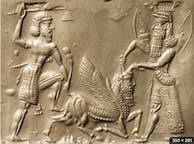
Gilgamesh's kingdom was situated in the river valleys between the Tigris and Euphrates in Southern Mesopotamia (modern day Southern Iraq). The land did not provide any wood or metals for building.8 Gilgamesh journeyed many days with his closest and most loyal friend, Enkidu, to retrieve lumber from the Cedar Forest in the mountains (modern day Lebanon and parts of Syria).9 The monster Humbaba, keeper and guardian of the Cedar Forest, however, blocked their way.10 Gilgamesh and Enkidu fought a great battle against Humbaba and defeated him. Upon his victory Gilgamesh brought back great cedars to his people for lumber to further build their city. The mythical monster Humbaba represents the treacherous mountain wilderness and the hostile tribes intent on protecting their forest.
In Trump's epic, the treacherous wilderness of politics and the Democratic political machine can be thought of symbolically as the monster Humbaba, blocking the way to the restoration of traditional values. Trump conquered “Humbaba” and brought the traditional values of law and order and meritocracy back to his people to restore and further build America.
The latter part of the epic transitions to a tragedy and has parallels in the Book of Genesis, namely the great flood, and the tree of life lost to a serpent. While it has less direct relevance to the hero's journey, I want to touch on one passage related to the great flood:11
Enlil heard the clamour and he said to the gods in council, “The uproar of mankind is intolerable and sleep is no longer possible by reason of the babel.” So the gods agreed to exterminate mankind.
This bears similarity to the rage and noise on every social media platform today. I wonder what the Judeo-Christian God thinks of this modern-day uproar and babel?
The story of the hero's journey is embedded in the subconscious of every human being. Epic heroes don’t have to be perfect people—they may be far from it. They do have to answer the calling, give up their comfortable life, fight great battles, and use their battle-hardened strengths to restore and improve their society. Trump’s supporters feel his hero’s journey deep in their bones, much as the Mesopotamian people felt for King Gilgamesh for over two thousand years.
All references to the N.K. Sandars and Andrew George translations are from the Penguin Classics editions.
1. Man and his Symbols, Carl Jung.
2. The Hero With a Thousand Faces, Joseph Campbell.
3. For a smooth, continuous story that merges versions from several excavation sites, see The Epic of Gilgamesh, translated by N.K. Sandars, Penguin Classics edition. The story is only 54 pages long.
For a reading of each collection of tablets by excavation site, with gaps, see the translation by Andrew George, Penguin Classics, second edition. Kindle version is recommended. The text in the paperback edition is very small.
4. Time Chart in George translation.
5. Sandars translation, Chapter 1, first page.
6. Sandars translation, Chapter 1; George translation, 1 Standard Version..., Tablets I and II.
7. Sandars translation, Chapter 1, final paragraph.
8. Sandars translation, Introduction, Section 3. The Historical Background, final two paragraphs.
9. Sandars translation, Chapter 2; George translation, 1 Standard Version..., Tablet IV.
10. Sandars translation, Chapter 2, final two paragraphs; George translation, 1 Standard Version..., Tablet V.
11. Sandars Translation, first page of Chapter 5.
These footnotes include some additional commentary, placed here so as not to disrupt the flow of the main article.
a. Also the media on both sides does everything it can to vilify the politicians on the other side.
b. Those values include individual liberty, limited government, and free markets.
c. Granted, the justification for denial was aided by some shady, last-minute changes to ballot rules in several key states—some of them implemented by executive agencies or lower courts. They did not go through the formal legislative process nor review by their state supreme courts.
d. From the Republican perspective, the reversal of illegal immigration was pivotal. Had Trump lost the 2024 election, the Democratic playbook would have continued much as it has in California: to keep the floodgates open and convert illegal immigrants—including many from Haiti, Somalia, and other relatively lawless countries—into Democratic voters. Democrats would likely have secured a long period of woke, socialist governance in the U.S. This motive was not lost on voters.
e. For an understanding of why Trump's unconventional oratory style works with some voters, see Win Bigly: Persuasion in a World Where Facts Don't Matter, Scott Adams.
f. It's interesting to note that Trump's style mirrors somewhat the approach in technology development known as *fail fast* where developers are encouraged to try things. If the thing doesn't work, change it. It's messy, but it can open up new avenues and can be a faster approach to the desired end state. The key is to pivot quickly when something isn't working.